How to Effectively Answer SHRM CP Situational Questions
· based on the channel PrepSolution
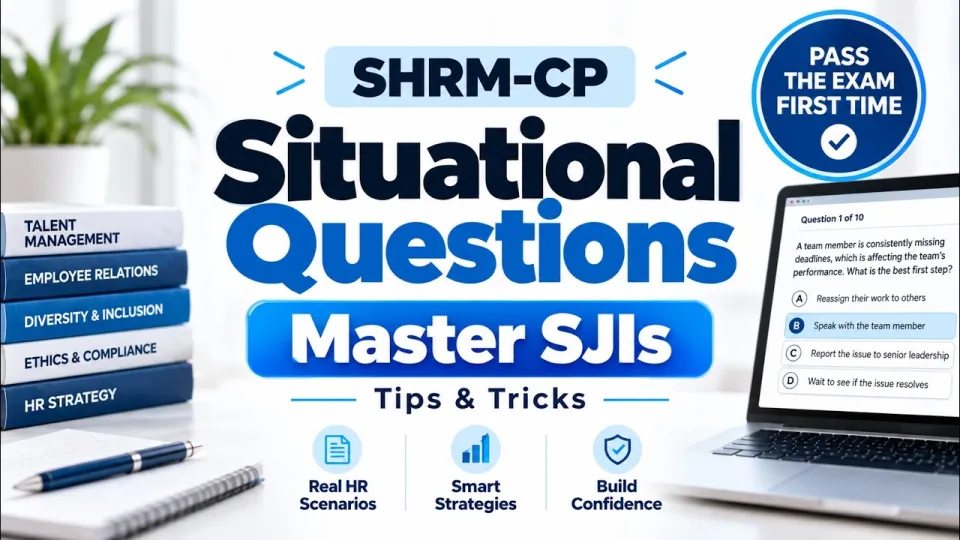
Situational questions on the SHRM CP exam challenge candidates to select the most appropriate response in complex HR scenarios. To successfully answer SHRM CP situational questions, it’s crucial to understand how to differentiate between several seemingly correct options and identify the best course of action. These questions assess your ability to analyze facts, apply HR policies, and make decisions consistent with legal and organizational standards. For free SHRM CP practice questions and exam resources, visit PrepSolution's free practice site.
Understanding SHRM CP Situational Questions
SHRM CP situational judgment questions, also known as SJIs, present real-world HR problems requiring you to pick the best response from multiple plausible answers. Unlike knowledge recall questions, SJIs test judgment by simulating workplace dilemmas where answers must be evaluated for effectiveness, compliance, and appropriateness. These questions often include four options that all seem reasonable, making the choice challenging.
Key to success is recognizing what the question specifically asks: Are you selecting the first immediate step to take, or the most effective overall solution? Reading the question carefully is essential to align your answer with the scenario’s demands.
Five Decision Checks to Identify the Best Answer
When tackling SHRM CP situational questions, apply five decision checks to each answer choice:
- Facts: Does the option align with the given scenario details? Avoid choices that conflict with established facts.
- Policy and Law: Is the action consistent with company policies and legal requirements? Eliminate answers that risk noncompliance.
- Appropriate Escalation: Does the response involve proper escalation without unnecessary involvement of higher authorities?
- HR’s Role: Is HR acting within their scope, supporting managers rather than taking over their responsibilities?
- People Involved: Are the relevant stakeholders considered appropriately in the decision?
Using these checks narrows down options by ruling out answers that fail any criteria.
Common Answer Traps and How to Avoid Them
SHRM CP situational questions often include answer traps designed to mislead candidates:
- Premature Action: Choosing an option that jumps to conclusions or disciplinary steps without gathering all information.
- Passive Responses: Selecting answers that avoid addressing the issue or delay resolution unnecessarily.
- Taking Over Manager’s Responsibilities: HR’s role is to advise and support, not replace managerial decisions.
- Unnecessary Escalation: Involving higher-level management when the issue can be resolved at the appropriate level.
- Legally Defective Options: Actions that could expose the organization to legal risks or violate employee rights.
Awareness of these traps helps you critically assess each choice and avoid common pitfalls.
Practical Tips to Eliminate Wrong Answers
To improve accuracy, test each answer against the scenario’s facts and wording, not just your own workplace experience. Follow these steps:
- Re-read the scenario carefully to ensure you understand the problem fully.
- Identify keywords in the question that specify the required action (e.g., "next step," "best resolution").
- Apply the five decision checks systematically to each option.
- Eliminate answers that conflict with facts, policies, or exceed HR’s role.
- Choose the answer that responsibly addresses the issue with appropriate escalation and legal compliance.
This methodical elimination process is more reliable than guessing based on familiarity or assumptions.
Example Scenario Walkthrough
Consider an HR scenario where a supervisor requests disciplining an employee after a shouting match. The question asks for how HR should respond. You might see options such as immediately disciplining the employee, investigating the incident, coaching the supervisor, or escalating to higher management.
Applying the decision checks:
- Immediate discipline without investigation is premature.
- Coaching the supervisor alone ignores the employee’s side.
- Escalating immediately may be unnecessary.
- Investigating first respects facts, ensures fairness, and aligns with HR’s advisory role.
Thus, the best answer is to conduct a thorough investigation before any disciplinary action.
How to Practice SHRM CP Situational Judgment Questions
Consistent practice with realistic SHRM CP situational questions improves your ability to recognize correct answers and avoid traps. Use resources like PrepSolution’s free SHRM CP practice questions to simulate exam conditions and refine your judgment skills. Analyze explanations for each question to understand why certain answers are superior.
Useful Links
Conclusion
Mastering SHRM CP situational questions requires understanding the nature of situational judgment tests, applying five key decision checks, and recognizing common answer traps. By methodically analyzing each option against facts, policy, escalation, HR’s role, and involved people, you can confidently select the best response. Practicing with quality materials, such as those provided by PrepSolution, further sharpens your skills and boosts exam readiness. Visit PrepSolution’s free practice question page to start improving today.
Key takeaways
- Situational Judgment Items (SJIs) test practical HR decision-making skills.
- Five decision checks guide the best answer: facts, policy, escalation, HR role, and people involved.
- Common traps include premature action, passive responses, and unnecessary escalation.
- Distinguish between the first step and the most effective step in scenarios.
- Practice with real SHRM CP questions improves recognition of correct answers.
Source: SHRM CP Situational Questions (SJIs) | TIPS TO PICK THE RIGHT ANSWER · Markdown version
Questions & answers
What are SHRM CP Situational Judgment Questions?
They are scenario-based questions that test your ability to apply HR knowledge and judgment in real workplace situations, requiring you to choose the best response from multiple options.
How do I decide between multiple seemingly correct answers?
Use the five decision checks: assess the facts, ensure compliance with policy and law, consider appropriate escalation, respect HR’s role, and involve the right people. This helps eliminate less suitable options.
What common traps should I watch for in situational questions?
Beware of premature actions, passive responses, taking over managerial duties, unnecessary escalation, and options that could lead to legal issues.
Where can I find practice questions for SHRM CP Situational Judgment?
PrepSolution offers free SHRM CP practice questions and detailed explanations at https://prepsolution.com/free-practice/shrm-cp?utm_source=youtube&utm_medium=video&utm_campaign=shrmcp_longform&utm_content=cp_long_v09.